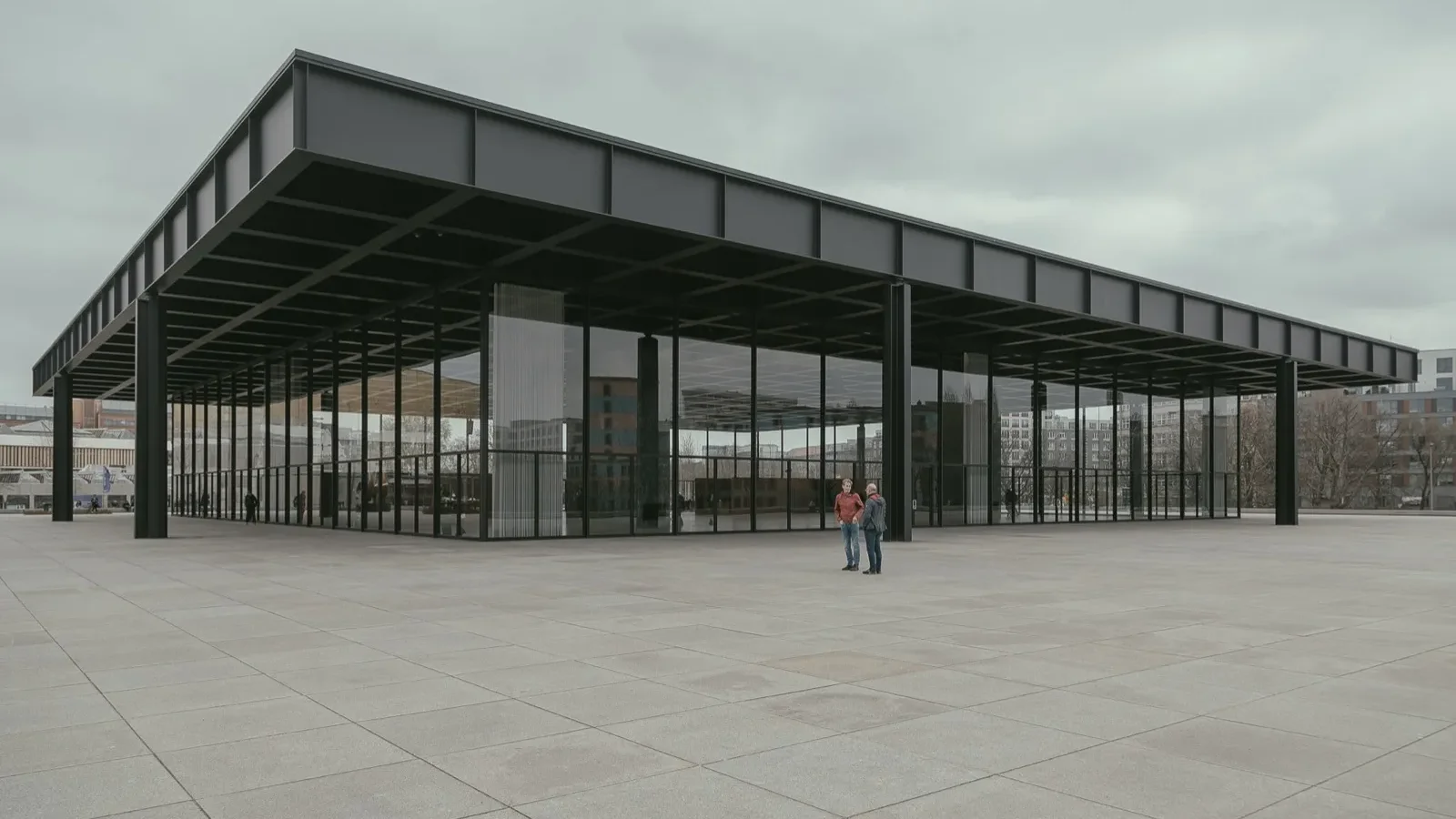
The Neue Nationalgalerie opens Ulay, Ulay & Abramović on Saturday 28 November 2026, a retrospective of the performance artist Ulay (Frank Uwe Laysiepen, 1943–2020). The date is not random: on 12 December 1976, Ulay took Carl Spitzweg's painting The Poor Poet off the wall of this museum and drove away with it. The show runs until 2 May 2027 and opens the evening before, Friday 27 November at 7pm.
The day Ulay stole the Poor Poet
The museum was then barely eight years old – Mies van der Rohe's glass hall had opened in 1968 – and Spitzweg's small 1839 picture of a poet in bed under a leaking roof was one of the best-loved paintings in West Berlin. Around 1pm on a Sunday in December, Ulay lifted it from the wall and left the building. He took it by car to the Künstlerhaus Bethanien and then to a flat in Kreuzberg where a Turkish guest-worker family lived, and hung it above their sofa in place of a reproduction.
The point was the route. A national treasure, guarded and insured, was briefly moved into the living room of people the city's cultural institutions did not count as their audience. Ulay filmed the whole action and called the film Irritation – There is a Criminal Touch to Art. Museum director Dieter Honisch collected the painting, undamaged, from the Künstlerhaus Bethanien; Ulay went back with him to the museum and gave himself up to the police. He was given the choice of a fine or prison, left the country, and was arrested later; according to the Schirn's account, friends raised the money for his release.
There is a second twist that the new exhibition cannot undo. The Berlin version of The Poor Poet was stolen for real on 3 September 1989, together with Spitzweg's The Love Letter, from Charlottenburg Palace, where the Nationalgalerie showed its 19th-century paintings at the time. Neither has been found. The version on view now is a loan from the Grohmann Museum in Milwaukee.
Ulay and Abramović in Berlin
The film is the centre of the show, which brings together videos, photographs, sculptures, drawings, sketches and letters. The early Polaroid series S'HE (1973–74) shows Ulay working on a split male–female identity; FOTOTOT (1976) consists of photographs made to fade when exposed to light.
The other half of the title belongs to the twelve years from 1976 to 1988 when Ulay worked with Marina Abramović. Their pieces are among the best-known performances of the century: Breathing In / Breathing Out, Rest Energy (1980), with a drawn bow aimed at Abramović's heart, and The Lovers (1988), the walk from opposite ends of the Great Wall of China that ended the partnership. Imponderabilia (1977), in which visitors squeeze between two naked performers standing in a doorway, is performed live every day from 3 to 4.30pm.
The exhibition is curated by museum director Klaus Biesenbach with Ricarda Bergmann and Alenka Gregorič of Cukrarna Gallery in Ljubljana, where part of the material was shown in 2025–26 as ART VITAL.
What it means for visitors
The Neue Nationalgalerie is running three shows at once this winter: Ulay, Maurizio Cattelan's NIGHT (Preis der Nationalgalerie, until 7 March 2027) and Christoph Schlingensief's Deutschlandsuche '99 (until 25 April 2027). The 20 € museum ticket covers all of them, which makes a long Thursday evening the sensible plan.
Be aware that the exhibition includes explicit nudity and depictions of injury, violence and physical pain, and that photographing or filming the Imponderabilia performers is not allowed.
Good to know
- Dates: 28 November 2026 – 2 May 2027; opening Friday 27 November, 7pm. Our exhibition guide has the practical details.
- Tickets: exhibition ticket 12 € (concessions 6 €); museum ticket for all exhibitions 20 € (10 €). Under-18s free.
- Hours: Tuesday to Sunday 10am–6pm, Thursday until 8pm, closed Monday.
- Free evenings: on the first Thursday of each month, 4–8pm, the museum is free under the Art4All programme; the Walk and Talk tour of the Ulay show on Thursday 3 December, 4pm, is part of it. Check on the day which rooms are included.
- Live performance: Imponderabilia daily 3–4.30pm.
- Access: step-free via the ramp at Reichpietschufer; nearest stop bus Potsdamer Brücke, U2/S-Bahn Potsdamer Platz about 850 m. More in our Neue Nationalgalerie visitor guide.
If the building interests you as much as the art, Mies van der Rohe's path to it started at the Bauhaus, which he moved to Berlin in 1932.